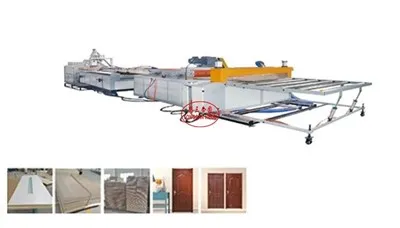
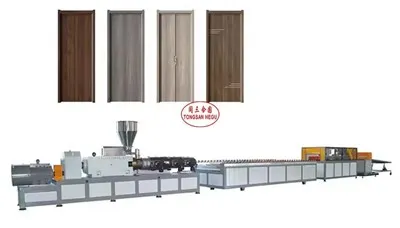
WPC (Wood – Plastic Composite) profile machines are essential equipment in the production of WPC products, which are widely used in construction, furniture, and interior decoration. As a WPC profile machine supplier, I often encounter customers who are confused about the differences between different models of these machines. In this blog, I will delve into the details of these differences to help you make an informed decision when purchasing a WPC profile machine. WPC Profile Machine
Production Capacity
One of the most significant differences between different models of WPC profile machines lies in their production capacity. Some machines are designed for small – scale production, which is suitable for start – up businesses or workshops with limited orders. These machines usually have a lower output rate, typically producing around 100 – 300 kilograms of WPC profiles per day. They are relatively compact in size, taking up less floor space in the factory, and are more cost – effective in terms of initial investment.
On the other hand, large – scale production models are built for high – volume manufacturing. These machines can churn out 500 kilograms or even more of WPC profiles per day. They are often equipped with more powerful motors and advanced extrusion systems, allowing for continuous and efficient production. However, they also require a larger production area, higher energy consumption, and a more substantial initial capital outlay.
For example, if you are planning to supply WPC profiles to a large – scale construction project or a chain of home improvement stores, a high – capacity machine would be a better choice. Conversely, if you are just starting in the WPC business with a small customer base, a low – capacity machine can meet your initial needs without excessive investment.
Extrusion Technology
The extrusion technology employed by different models of WPC profile machines also varies. There are mainly single – screw extrusion and twin – screw extrusion machines.
Single – screw extrusion machines are relatively simple in structure. They are suitable for producing WPC profiles with relatively low – precision requirements and simpler cross – sectional shapes. The material is pushed forward through the barrel by the rotation of a single screw. This type of machine is generally more affordable and easier to operate and maintain. However, its mixing ability is limited, and it may not be able to handle complex formulations or high – filler content materials effectively.
Twin – screw extrusion machines, on the other hand, offer better mixing and plasticizing performance. They have two intermeshing screws that rotate in the same or opposite directions. The twin – screw design allows for more intense mixing of the wood flour, plastic resin, and additives, resulting in a more homogeneous WPC material. This is particularly important for producing high – quality profiles with complex cross – sections and excellent mechanical properties. Twin – screw extrusion machines are more commonly used in the production of high – end WPC products, but they are also more expensive and require more technical expertise for operation and maintenance.
Profile Size and Shape Flexibility
Different models of WPC profile machines vary in their ability to produce profiles of different sizes and shapes. Some machines are designed to produce a specific range of profile sizes and shapes, while others offer more flexibility.
Machines with limited flexibility are often optimized for a particular type of WPC product. For example, a machine may be specifically configured to produce decking boards of a certain width and thickness. These machines are usually more cost – effective for mass – producing a single type of product because they are highly specialized and can achieve high production efficiency.
In contrast, machines with high flexibility can produce a wide variety of profile sizes and shapes. They are equipped with interchangeable dies and adjustable extrusion parameters. This allows manufacturers to quickly switch between different product specifications in response to market demands. However, these machines are generally more complex and may have a slightly lower production efficiency for a single product compared to specialized machines.
Automation Level
The automation level of WPC profile machines also differs from model to model. Low – end machines may have a relatively low degree of automation, requiring a significant amount of manual intervention in the production process. For example, tasks such as feeding materials, controlling the extrusion speed, and cutting the profiles may need to be done manually. These machines are more suitable for small – scale operations where labor costs are relatively low.
High – end machines, on the other hand, are highly automated. They are equipped with advanced control systems, such as PLC (Programmable Logic Controller), which can precisely control the temperature, pressure, and speed of the extrusion process. Automated feeding systems ensure a consistent supply of raw materials, and automatic cutting systems can accurately cut the profiles to the desired length. This not only improves production efficiency but also reduces the risk of human error and ensures product quality stability. However, automated machines are more expensive and require a certain level of technical expertise for programming and maintenance.
Energy Efficiency
Energy efficiency is an important consideration for any manufacturing equipment, and WPC profile machines are no exception. Different models of machines have different energy consumption levels, which can have a significant impact on production costs in the long run.
Some machines are designed with energy – saving features, such as advanced heating and cooling systems. For example, induction heating technology can heat the extrusion barrel more efficiently than traditional resistance heating, reducing energy waste. Additionally, well – designed cooling systems can quickly dissipate heat from the extruded profiles, allowing for faster production cycles without excessive energy consumption.
In contrast, older or less – efficient models may consume more energy, resulting in higher production costs. When choosing a WPC profile machine, it is important to consider the energy efficiency of the machine, especially if you plan to operate it for long hours or in a large – scale production environment.
After – Sales Service and Technical Support
Another difference between different models of WPC profile machines is the after – sales service and technical support provided by the supplier. As a WPC profile machine supplier, I understand the importance of providing comprehensive after – sales service to our customers.
Some suppliers may offer only basic after – sales service, such as providing spare parts and limited technical advice. Others, like us, go the extra mile by offering on – site installation and commissioning, operator training, and long – term technical support. We also maintain a large inventory of spare parts to ensure quick replacement in case of machine breakdowns.
When choosing a WPC profile machine, it is crucial to consider the after – sales service and technical support offered by the supplier. A reliable supplier can help you minimize downtime, improve production efficiency, and ensure the long – term operation of your machine.
In conclusion, when considering purchasing a WPC profile machine, it is essential to understand the differences between different models in terms of production capacity, extrusion technology, profile size and shape flexibility, automation level, energy efficiency, and after – sales service. By carefully evaluating your specific production needs, budget, and long – term business goals, you can select the most suitable machine for your operation.
Corrugated Pipe Machine If you are interested in learning more about our WPC profile machines or have any questions regarding WPC production, please feel free to contact us for a detailed consultation. Our team of experts is ready to assist you in making the best decision for your business.
References
- "Wood – Plastic Composites Handbook" edited by Lawrence T. Drzal, Istvan Guravich, and Xiantong Fang.
- "Extrusion: The Definitive Processing Guide and Handbook" by Christopher Rauwendaal.
Qingdao Tongsanhegu Plastic Machinery Manufacturing Co., Ltd.
With abundant experience, we are one of the most reliable wpc profile machine manufacturers and suppliers in China. We warmly welcome you to buy durable wpc profile machine for sale here from our factory. Quality products and reasonable price are available.
Address: West of Xixinzhi Village, Sanlihe District Jiaozhou, Qingdao City, Shandong Province, China
E-mail: info@tongsanhegu.com
WebSite: https://www.tongsanhegumachine.com/
