If you’ve ever stood next to a forklift gliding across a concrete warehouse floor or a front loader hauling construction aggregate on gravel, you’ve probably noticed how solid tires hold their grip—no skidding, no sudden slides, even under heavy load. As the owner of a solid tire supplier that’s worked with material handling and construction teams for over a decade, I get asked this question more than almost any other: What is the traction coefficient of solid tires? It’s not a simple number you can pull off a spec sheet and call it a day, though. It’s a balance of rubber compound, tire design, surface conditions, and even the weight the tire’s carrying—things that make solid tires different from their pneumatic cousins, and why choosing the right traction doesn’t have to mean settling for less durability. Solid Tire

First, let’s break down what traction coefficient actually is, in plain terms, because I’ve seen too many customers glaze over when I pull out physics jargon. At its core, traction coefficient is a ratio that measures how much friction exists between a tire and the surface it’s on. The formula is simple: divide the force needed to keep a tire from sliding sideways (or forward, when accelerating) by the total weight pressing the tire into the ground. If a tire has a traction coefficient of 0.8, that means 80% of its load weight is the maximum force it can handle before slipping. For anyone running a warehouse or a construction site, that number isn’t just a stat—it’s what keeps pallets from crashing, loads from spilling, and operators from getting hurt.
Now, here’s where solid tires stand out, and where a lot of misinformation gets spread around. Pneumatic tires get their traction mostly from the flex of their rubber and the air inside them, which lets them conform slightly to uneven surfaces. Solid tires, by contrast, are made of a dense, cured rubber compound molded into a rigid shape—no air, no give. That changes how friction works, but it doesn’t mean solid tires have worse traction. In fact, under specific conditions, their traction coefficient can be more consistent than pneumatic tires, which lose grip when they’re underinflated or have a puncture.
Let’s get into the numbers, because that’s what most people want to know. For solid rubber tires on dry, smooth concrete—like the floors of a refrigerated warehouse or a loading dock—their traction coefficient usually falls between 0.6 and 0.8. That’s on par with many quality pneumatic tires designed for similar use. But move to a rougher surface, like packed gravel or wet warehouse concrete with a tiny bit of dust, and that number shifts. On wet concrete, solid tires typically drop to 0.4 to 0.6, which is still reliable enough for most material handling tasks because their rigid shape doesn’t squirm like a pneumatic tire does when weight shifts. On loose surfaces, like construction aggregate or wet grass, traction drops even more—usually 0.3 to 0.5—but that’s not a failure of the solid tire; it’s a function of how much the surface itself can support.
What most people don’t realize is that traction coefficient for solid tires isn’t one-size-fits-all. It depends almost entirely on how we, as tire suppliers, design the rubber compound and the tire’s tread pattern. For example, if we make a solid tire with a softer rubber compound (think of the rubber on a new pencil eraser, not the hard rubber on a truck tire), the traction coefficient goes up because the rubber adheres better to the surface. But softer rubber wears faster, especially when you’re running a 10,000-pound forklift 12 hours a day. That’s why we balance it: we’ll add a small amount of a synthetic polymer to the rubber to boost grip without sacrificing the durability that solid tires are known for. Conversely, if a customer is running a tire in a facility with lots of sharp debris and constant turns, we’ll use a slightly harder compound—their priority is less frequent tire changes, not maximum grip on smooth concrete. Tread patterns matter too. A smooth solid tire (common in indoor warehouses with perfect floors) has a higher traction coefficient than a tire with deep, blocky treads, because the smooth surface makes more direct contact with the ground. Treaded solid tires are for outdoor use, where they need to clear mud or gravel, but that tread cuts into the contact area, lowering traction a little.
I’ve seen first-hand what happens when companies pick the wrong traction coefficient for their needs. A construction client of mine called us two years ago, frustrated with solid tires that kept sliding on the muddy access roads to a job site. They’d ordered standard smooth solid tires, meant for indoor work, and expected them to handle their outdoor hauling. Their traction coefficient was around 0.5 on dry gravel, but dropped to 0.2 on wet mud—way too low for their front loaders, which were tipping at low speeds and spilling rock. We worked with them to redesign their tire: we used a medium-hard rubber compound that maintained grip, and added shallow, zig-zag treads that let mud shed without sacrificing contact area. The new tires had a traction coefficient of 0.4 on wet mud, and they lasted three times longer than the pneumatic tires they’d been using, which were getting punctured every other week. That’s the sweet spot, right? Traction that works for your job, not just a number on a spec sheet.
Another common myth is that solid tires have lower traction than pneumatic tires. Let’s test that in real scenarios. On dry concrete, a pneumatic tire has a traction coefficient of about 0.7 to 0.9, which is close to solid tires. But if that pneumatic tire has a 10% air leak, its contact area shrinks, and traction drops to 0.5 or lower. On the other hand, a solid tire’s contact area stays the same no matter how much weight it’s carrying—its rigid shape distributes weight evenly across the entire surface that touches the ground. For a forklift lifting 8,000 pounds, that consistent contact means the traction coefficient doesn’t fluctuate as much as it does with a pneumatic tire. I’ve had warehouse managers tell us that their solid tires stop faster than the pneumatic ones they replaced, because the grip is steady, not dependent on air pressure.
There are also factors outside the tire itself that change traction coefficient, and it’s my job to make sure customers know these, not just the tire specs. The surface condition is the biggest one: a concrete floor with a light layer of dust has a lower traction coefficient than a swept, clean floor. A gravel road with loose rocks is slipperier than compacted gravel. Even the way you use the equipment matters: hard braking or sudden turns can lower the effective traction, because the tire skids before it can build up full friction. That’s why we always advise customers to pair the right tire with operator training—even a tire with a 0.8 traction coefficient won’t help if someone’s slamming on the brakes around every corner.
For us as a solid tire supplier, the traction coefficient isn’t just a number we put on our website to look technical. It’s a tool we use to solve problems. When a food processing plant client needed tires that wouldn’t leave black rubber marks on their stainless steel floors, we designed a solid tire with a special food-grade rubber compound that had a slightly lower traction coefficient (0.55 on smooth concrete) but no scuffing, and lasted twice as long as their previous pneumatic tires. When a mining client needed tires that could handle both concrete shop floors and rough outdoor haul roads, we offered a two-stage solid tire: a harder rubber core for durability, and a softer outer layer for grip, with a traction coefficient that stayed between 0.45 and 0.6 across all surfaces they worked on.
If you’re sitting here thinking, “I just need tires that don’t slip and don’t wear out,” that’s exactly what we’re here to help with. Traction coefficient is a great starting point, but it’s not the only thing you should consider when buying solid tires. You need to think about where you’re using the tire, how much weight it’s carrying, how many hours a day it’s running, and what kind of surface it’s touching. A tire that has a high traction coefficient on dry concrete will be useless on muddy gravel, and a tire built for outdoor durability will wear out fast in an indoor warehouse.
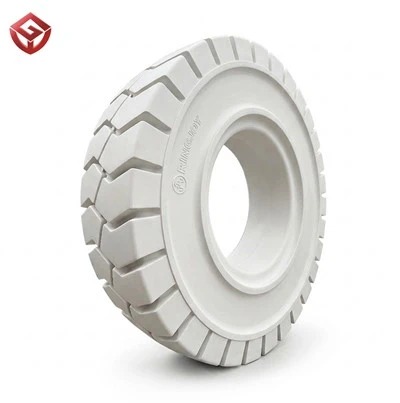
At the end of the day, the best solid tire for your operation is the one that balances traction, durability, and cost. We’ve spent years testing compounds and designs to get that balance right, and we don’t cut corners just to have a higher traction number on paper. If you’re tired of pneumatic tires that get punctured, lose air, or slide when you need them most, or if you’re just not sure what traction coefficient you need for your application, we’re here to walk through it with you. We can talk through your job site conditions, the equipment you’re running, and what matters most to you—whether that’s less downtime, better safety, or lower long-term costs. Don’t hesitate to reach out to discuss your solid tire needs and find the right solution for your operation.
Solid Tire References
- Grosch, K. A. (1963). The Relation Between the Friction and Wear of Rubber Tires and Their Viscoelastic Properties. Proceedings of the Royal Society of London. Series A, Mathematical and Physical Sciences, 274(1356), 21–42.
- Osta, M. C., & Al-Quraan, A. (2018). Traction Performance of Solid Rubber Tires on Different Pavement Surfaces. Journal of Terramechanics, 78, 31–39.
- International Organization for Standardization. (2020). Rubber Tires for Material Handling Equipment – Terms, Definitions and Test Methods. ISO 1757:2020.
- Clark, S. K. (1981). Mechanics of Pneumatic Tires. National Highway Traffic Safety Administration.
- Wang, Y., Li, Z., & Zhang, L. (2021). Design and Performance Analysis of High-Traction Solid Rubber Tires for Construction Machinery. Construction and Building Materials, 297, 123789.
Zhejiang Guowei Rubber Co., Ltd.
Zhejiang Guowei Rubber Co., Ltd. is one of the most professional solid tire manufacturers and suppliers in China. With abundant experience, we warmly welcome you to buy advanced solid tire in stock here and get pricelist from our factory. Quality products and reasonable price are available.
Address: No. 10, Nanyang 4th Road, Duqiao Town, Linhai City, Taizhou, Zhejiang Province, China
E-mail: gwsolid@gmail.com
WebSite: https://www.forkliftsolidtires.com/
