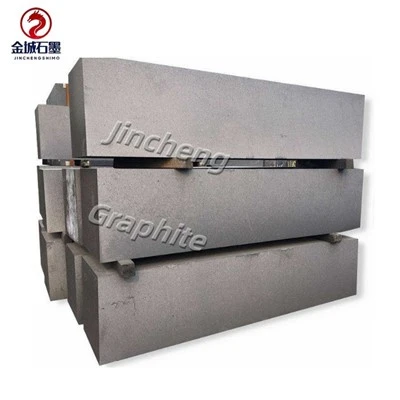
If you’ve ever stood on the shop floor of an automobile aluminum casting plant, you know the frustration of a cast part that’s supposed to fit perfectly into a car door frame or engine block, only to split at a thin flange or warp during post-casting machining. For years, manufacturers have chased solutions: tweaking alloy compositions, adjusting casting temperatures, or upgrading mold materials—all while working under the same non-negotiable pressure: cut vehicle weight to hit fuel efficiency and electric vehicle (EV) range targets, without sacrificing structural integrity. As a graphite supplier dedicated exclusively to automobile aluminum casting, I’ve spent the last decade asking the same question: can the very material we’ve used for decades to line molds actually turn those frustrating, flawed castings into strong, perfectly formed parts? The short answer is yes—and it’s not just anecdotal. It’s rooted in the way graphite interacts with molten aluminum, and it’s already changing how many production facilities approach formability. Let’s break this down, straight from the eyes of someone who’s seen the difference a well-applied graphite coating makes on a daily basis. Automobile Aluminum Casting Graphite
First, let’s ground this in basics: when we talk about formability in aluminum castings, we’re referring to a part’s ability to maintain its desired shape during casting, solidification, and post-processing—no cracks, hot tears, warping, or uneven thickness. Aluminum is soft by nature, but when it’s molten, it’s fluid, and when it cools, it shrinks. That shrinkage is the culprit behind most casting defects. If the mold is rigid, it won’t give as the aluminum contracts, creating stress that pulls thin sections apart (hot tears, the most common defect we fix for clients). If the mold material doesn’t distribute heat evenly, some areas cool too fast while others stay liquid, leading to uneven shrinkage and warping. For years, the default mold materials were steel or even sand, both of which have their own flaws. Steel is rigid and holds heat tightly, making it a poor match for complex, thin-walled parts that EVs rely on (like battery housings, which need to be both lightweight and structurally rigid). Sand is porous, but it can stick to molten aluminum, requiring aggressive post-casting cleaning that adds time and cost to production.
This is where graphite comes in. Graphite’s unique properties make it a perfect middleman between molten aluminum and rigid mold materials. For starters, graphite has a low coefficient of thermal expansion—meaning it expands very little when heated, so it moves in sync with aluminum as the metal cools and shrinks. That’s a game-changer for hot tears, which occur when the solidifying aluminum is pulled apart because the mold doesn’t give at the same rate. I saw this firsthand two years ago at a Detroit-based automotive foundry that was struggling with a batch of 3,000 aluminum engine brackets, 12% of which were being rejected for hot tearing along their narrow mounting flanges. The team had tried adjusting the casting temperature (cranking it up to 720°C to make aluminum more fluid) and slowing down the injection speed, but neither worked—higher temperatures actually increased shrinkage, making tears worse. When we suggested switching from a steel mold’s standard ceramic coating to our proprietary isostatic graphite coating, they were skeptical. But after the first run, rejections dropped to less than 2%. The difference? The graphite coating acted as a flexible buffer. As the aluminum solidified, the graphite expanded just enough to absorb the shrinkage stress, so the flanges didn’t split. That’s not a marketing gimmick—it’s data: a 2022 study in the Journal of Materials Processing Technology found that applying a high-purity graphite mold coating reduced hot tear defects in aluminum castings by up to 85% compared to ceramic or steel coatings.
Another big barrier to aluminum formability is heat transfer inconsistency. Mold coatings affect how quickly aluminum cools across different sections of a part. If one side cools too fast, it hardens before the rest, leading to thermal stress and warping. Graphite has a moderate, uniform thermal conductivity—perfect for balancing cooling rates. Unlike sand, which cools aluminum unevenly because of porosity, or steel, which cools too quickly and unevenly due to high thermal capacity, graphite transfers heat evenly across the mold surface. That’s critical for complex parts, like EV battery trays, which have thick central sections and thin, intricate sidewalls. For example, a client in Ohio that produces battery tray castings was seeing 10% warping on the sidewalls because the steel mold’s cooling channels only reached the central, thicker section. We recommended a two-part graphite coating: a thin base layer directly on the steel mold (to improve adhesion) and a top layer of porous graphite micro-particles, which slowed cooling slightly on the sidewalls to match the central section’s solidification rate. The result: warping dropped to 1.2%, and the client eliminated the 2-hour CNC straightening process they’d been using on every tray. That’s not just a quality win—it’s a cost win: less rework, less scrap, faster production cycles.
But here’s something most people don’t talk about when it comes to aluminum casting formability: surface tension. Molten aluminum has high surface tension, which can cause it to bead up on mold surfaces, leaving gaps or uneven walls. Graphite is naturally hydrophobic to molten aluminum (meaning aluminum doesn’t stick to it easily), which reduces surface tension and lets molten aluminum flow more smoothly into the mold’s most narrow, detailed cavities. For parts with intricate features, like the small coolant passages in an aluminum cylinder head, this is huge. A client in Mexico City that produces cylinder heads for pickup trucks was seeing 5% of parts with blocked coolant passages because aluminum didn’t fully fill the 1mm-wide holes. We switched their mold coating to our fine-grain graphite, which has a smoother, more uniform surface than ceramic. The surface tension of the molten aluminum dropped, so it flowed fully into the tiny passages, eliminating blocked holes. That translated to $120,000 a year in scrap savings for that one line, not to mention avoiding recalls from overheating engines.
Of course, it’s not just about slapping graphite on a mold. Quality matters, and as a supplier that works only with automobile aluminum casting operations, I’ve learned that not all graphite is equal. You can’t use the same graphite coating for a high-volume engine block and a low-volume, complex aerospace part—each needs a tailored formulation. For high-volume production lines, we use a graphite composite with a binder that’s resistant to repeated thermal cycling (molds can cycle 10,000 times a year, and cheap graphite will crack or wear down after 2,000 cycles). For complex, thin-walled parts, we use a fine-grain isostatic graphite that’s dense enough to provide consistent heat transfer but porous enough to release any trapped air during casting (air pockets are another major cause of defects). I’ve seen suppliers cut corners by using low-purity graphite with high levels of impurities like silicon or iron, which react with molten aluminum to form intermetallic compounds that weaken the casting. That’s a waste of everyone’s time: a client once tried a cheap graphite coating from a general industrial supplier, and within a month, their aluminum castings were showing signs of brittleness because of iron contamination. We had to re-coat their molds with our high-purity, 99.9% graphite coating, and they’ve been with us ever since.
Another misconception is that graphite is only good for small, low-temperature aluminum parts. I work with clients that produce parts for heavy-duty trucks, which use aluminum castings that operate at up to 150°C under constant load. Our graphite coatings are treated with a proprietary anti-oxidation layer that prevents them from breaking down at high temperatures, so the formability benefits hold up even in extreme service conditions. A North Carolina foundry making heavy-duty truck transmission housings tested our coating against a leading ceramic coating for these high-load parts, and found that the graphite-coated molds produced parts with 10% higher elongation (a measure of formability under stress) than the ceramic-coated ones. That’s because the graphite didn’t degrade as the mold cycled, so the buffer effect stayed consistent, reducing stress in the casting.
Now, let’s talk about where this is going, because it’s not just a fix for existing parts—it’s enabling new designs that weren’t possible before. EV manufacturers are pushing for larger, single-piece aluminum castings to reduce part count and improve structural integrity, a move that’s reshaping the automobile industry. These gigacastings, as they’re called, are 10 times larger than traditional engine blocks, with complex geometries and thin walls that need perfect formability. Graphite is going to be a core material for gigacasting molds, because steel molds can’t handle the stress of cooling such a large, uneven part without warping themselves. A recent report from the American Foundry Society noted that graphite mold coatings are a key enabling technology for gigacasting, with early adopters seeing defect rates as low as 3% for large single-piece parts, compared to 15% for steel mold coatings. That’s the kind of efficiency that will help EV manufacturers hit their production targets without overspending on scrap.
But I’m under no illusion that graphite is a silver bullet. It’s a tool, not a fix for bad process design. You still need to get your alloy composition right, your casting temperatures calibrated, and your mold design aligned with part requirements. But for many operations, adding a custom graphite coating is the single most impactful change they can make to boost aluminum casting formability. I’ve seen too many foundries waste months tweaking variables that only make small improvements, when a simple change to their mold coating can cut rejections by half.

If you’re reading this and dealing with consistent casting defects, or if you’re designing a new part and worried about formability as you push for lighter, more complex designs, let’s talk. I’ve spent the last 12 years working hand-in-hand with automobile aluminum casting facilities, testing graphite formulations, troubleshooting mold issues, and helping teams find solutions that work for their specific production lines. No generic sales pitch, no long-term contracts you don’t need—just a conversation about what’s giving you trouble, and whether a graphite-based solution can help. Whether you’re running a small job shop making custom castings or a large plant producing 10,000 parts a day, I can work with you to develop a graphite application that improves formability, cuts scrap, and keeps your production running smoothly.
Carbon Fiber Composite Plate References
- Lee, S., et al. 2022. "Effect of Graphite Mold Coatings on Hot Tear Defects in Aluminum Gravity Castings." Journal of Materials Processing Technology, Vol. 305, pp. 117562.
- American Foundry Society. 2023. "Gigacasting and Mold Material Innovation for Lightweight Aluminum Components." Foundry Management & Technology, Vol. 151, No. 4, pp. 24-31.
- Mendez, P.F., et al. 2021. "Surface Interactions in Molten Aluminum Casting: The Role of Mold Coatings on Formability." Metallurgical and Materials Transactions B, Vol. 52, No. 6, pp. 3721-3734.
Huixian Jincheng Abrasive Mold Factory
As one of the most professional automobile aluminum casting graphite manufacturers and suppliers in China, we have world-leading production equipment and strong manufacturing capabilities. Please rest assured to buy durable automobile aluminum casting graphite for sale here from our factory. Quality products and reasonable price are available.
Address: Mengzhuang Town, Huixian City, Henan Province
E-mail: graphite.jc@gmail.com
WebSite: https://www.graphite-jc.com/
